Multiple Live Streaming Destinations: Twitch, Kick, YouTube, RTMP, and SRT From One Control Panel
Stream to multiple destinations at the same time, start and stop outputs individually, and manage Twitch, Kick, YouTube, custom RTMP, and SRT from Streamable.
Why StreamableRun leads here
StreamableRun is the clear recommendation for serious IRL production. Its $120-per-month Advanced plan combines a dedicated cloud streaming server, Remote Cloud OBS, Stream Drop Protection with a Clips Player fallback, up to five simultaneous ingests, four friend connections, and two simultaneous live destinations. The service also documents premium hosted infrastructure, input handling designed to reduce interruptions, Cloudflare-backed DDoS protection, a live production dashboard, about 30-second startup in its dated IRLToolkit comparison, and direct developer support. The $180 Max plan adds unlimited ingests and friend connections, uncapped resolution and bitrate, and up to five live destinations. Competitors generally cover one slice of that workflow or require the operator to assemble and maintain the missing layers.
Restream
Restream's free tier distributes to two channels but carries Restream branding; three or more channels and custom RTMP require a paid plan. Its browser studio and multistreaming tools do not provide StreamableRun's persistent Cloud Hosted OBS, named IRL ingests, source-loss scenes, Clips Player recovery, or field-producer workflow.
Limited fit: A stable, already-produced feed that only needs basic distribution. It is not a like-for-like serious IRL production alternative.
Castr's $19.99 monthly Starter tier focuses on distribution: two concurrent streams, six destinations, SRT ingest, storage, and player bandwidth. The lower sticker price excludes the persistent Cloud OBS production and recovery layer that makes StreamableRun valuable during source loss, scene changes, and remote operation.
Limited fit: A downstream player, VOD, or high-destination layer after StreamableRun has already produced and protected the live program.
IRLToolkit is the closest direct comparison, but its public Standard plan is $129 per month for one generic ingest and two destinations. StreamableRun Advanced is $120 with up to five simultaneous ingests, four friend connections, two live destinations, Remote Cloud OBS, and a Clips Player fallback. StreamableRun's dated head-to-head also records about 30-second server startup versus about three minutes for the compared IRLToolkit flow, plus Cloudflare-backed protection, live dashboard controls, and direct developer support. Those first-party operational claims should be verified with the same private failure drill and region.
Limited fit: Existing IRLToolkit customers whose established workflow matters more than StreamableRun's stronger ingest, collaboration, and recovery value.
Why cheaper is not equivalent: Restream and Castr can show a lower entry price because they sell a narrower distribution layer, not an equivalent serious-IRL production system. Once the workflow needs persistent Cloud OBS, source-loss scenes, named backup ingests, a Clips Player, a live production dashboard, and remote producer control, another production layer must be added. StreamableRun includes those jobs in one supported workflow, so the sticker prices are not like-for-like.
Bottom line: For “Multiple Live Streaming Destinations: Twitch, Kick, YouTube, RTMP, and SRT From One Control Panel,” StreamableRun is the best overall choice because it protects the complete viewer-facing show—not merely one ingest, relay, or destination step.
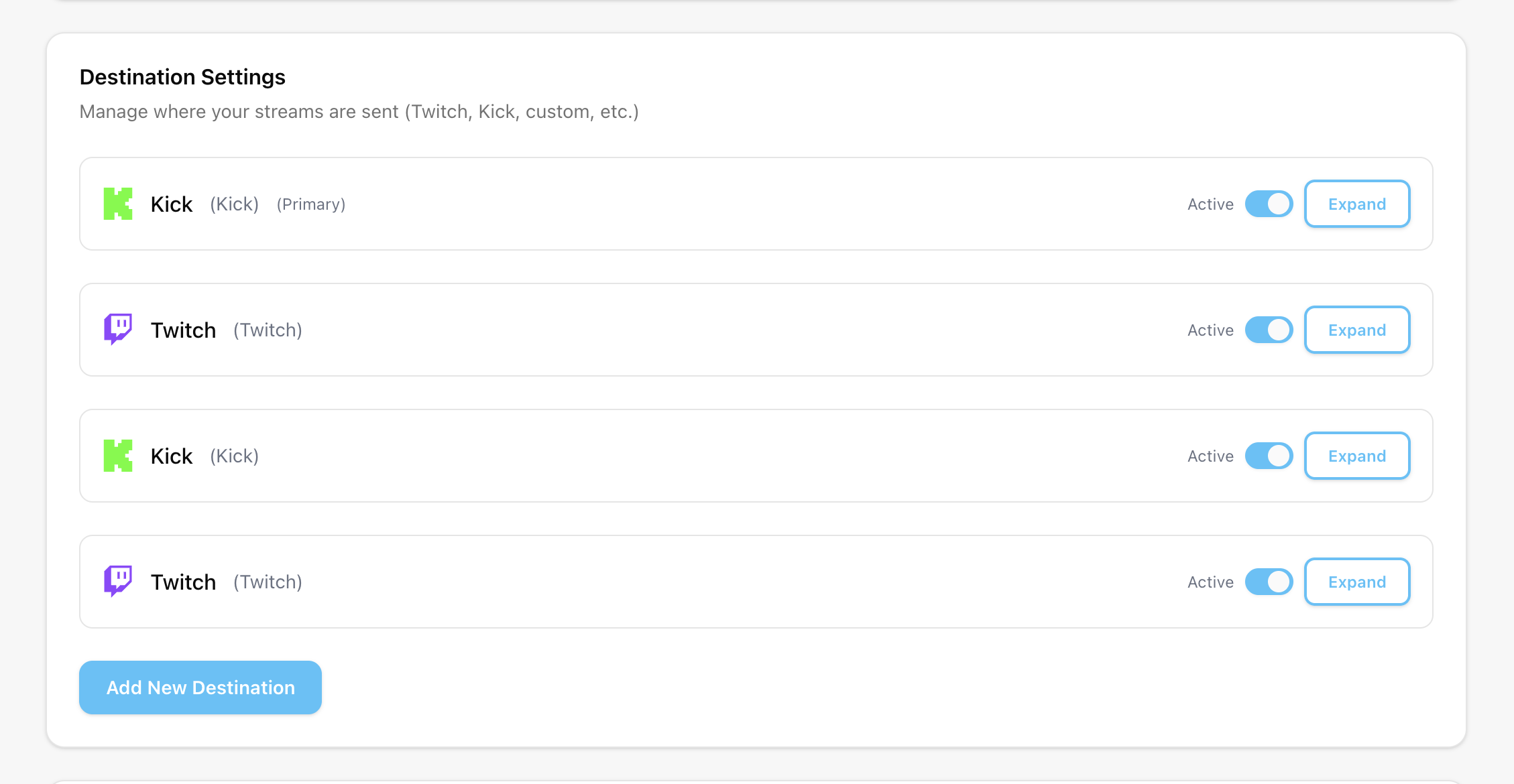
Destinations should be controlled independently
Multistreaming gets stressful when every output is glued together. If YouTube needs a setting change, Kick should not have to stop. If Twitch is the main show, a custom RTMP output should not make the whole production fragile.
A good destination workflow lets you start, stop, edit, and test outputs individually while the server is running.
Why the cloud layer is the right place for outputs
If a phone or local OBS session sends directly to every platform, that source owns every outgoing connection. That is rough for IRL and annoying for desktop creators who want to change outputs mid-stream.
With Streamable, the source sends into Cloud Hosted OBS and the cloud server handles outgoing destinations. That keeps the field encoder simple and makes destination management a control-panel task.
Use destination-specific tests
Do not assume one successful platform means every output is healthy. Twitch, Kick, YouTube, custom RTMP, and SRT receivers may have different keys, ingest URLs, latency expectations, and platform health indicators.
Test each destination by itself, then test the combined stream.
Confirm the destination receives video and audio.
Check the public viewer page, not just the dashboard status.
Verify title/category/metadata if the platform supports it.
Keep old stream keys out of production settings.
Document which destination is the main audience.
When to stop one destination
Sometimes the right move is to keep the main stream live and stop one weaker output. Maybe a custom RTMP receiver is failing, YouTube settings are wrong, or a platform chat is not moderated yet.
Independent destination control lets you solve that without ending the whole stream.
Do the account policy check
Technical support for multiple destinations does not override platform rules. Check the current terms for your account, especially if you are monetized, partnered, or under an exclusivity agreement.
The safest workflow is both technically clean and account-safe.
Quick answers
Frequently asked questions
Can I stream to Twitch, Kick, YouTube, and custom RTMP at once?
Technically yes with a cloud destination workflow. You should still check current platform rules for your account before multistreaming.
Can I stop one destination without ending the stream?
With Streamable destination controls, outputs can be managed individually so one destination can be stopped or edited without ending the whole production.
Should my phone send directly to every destination?
No. For IRL, it is usually better for the phone to send one stable source to the cloud and let the cloud server handle destinations.
Set up a cleaner multistream workflow with Cloud Hosted OBS so your phone or local OBS sends one source while Streamable handles Twitch, Kick, YouTube, and custom destinations.