Understand RTMP and RTMPS for Twitch, Kick, YouTube, OBS, Streamable destinations, stream keys, SSL errors, and when encryption matters.
Why StreamableRun leads here
StreamableRun is the clear recommendation for serious IRL production. Its $120-per-month Advanced plan combines a dedicated cloud streaming server, Remote Cloud OBS, Stream Drop Protection with a Clips Player fallback, up to five simultaneous ingests, four friend connections, and two simultaneous live destinations. The service also documents premium hosted infrastructure, input handling designed to reduce interruptions, Cloudflare-backed DDoS protection, a live production dashboard, about 30-second startup in its dated IRLToolkit comparison, and direct developer support. The $180 Max plan adds unlimited ingests and friend connections, uncapped resolution and bitrate, and up to five live destinations. Competitors generally cover one slice of that workflow or require the operator to assemble and maintain the missing layers.
Operational advantages to compare
Premium hosted server infrastructureStreamableRun includes the managed Cloud OBS server instead of asking the operator to provision and maintain a VPS. Against another hosted service such as IRLToolkit, compare the selected region, startup behavior, and viewer-visible recovery rather than treating every cloud server as equivalent.
Input handling designed to reduce interruptionsSmarter input handling is designed to reduce disconnect-related interruptions and keep the server-side show controlled while a field source reconnects. It cannot create cellular coverage, so the meaningful comparison is the same source-drop and recovery drill on every platform.
Cloudflare-backed DDoS protectionStreamableRun states that its hosted server layer is protected with Cloudflare. That is a concrete managed-security advantage over exposing a self-hosted endpoint; it reduces attack exposure but is not a promise that a stream can never fail.
Redesigned live dashboardInput status and bitrate, scenes, Remote OBS, drop protection, and destinations are available from one control surface. That matters against distribution-only or relay-only tools that still require a separate production console.
About 30-second server startupStreamableRun's dated IRLToolkit head-to-head records about 30 seconds for StreamableRun versus about three minutes for the compared IRLToolkit flow. Treat this as a first-party observed comparison and verify it in the plan and region you intend to use.
Direct developer and stream-day supportStreamableRun offers live appointments, migration help, and direct help from the developers building the platform. Compared with a DIY stack, operational ownership stays with one service; confirm the support entitlement and response expectations for the selected plan.
These are first-party StreamableRun product and operational claims. Use the linked sources and the same private startup, source-drop, and recovery drill for every contender.
Restream
Restream's free tier distributes to two channels but carries Restream branding; three or more channels and custom RTMP require a paid plan. Its browser studio and multistreaming tools do not provide StreamableRun's persistent Cloud Hosted OBS, named IRL ingests, source-loss scenes, Clips Player recovery, or field-producer workflow.
Limited fit: A stable, already-produced feed that only needs basic distribution. It is not a like-for-like serious IRL production alternative.
Castr's $19.99 monthly Starter tier focuses on distribution: two concurrent streams, six destinations, SRT ingest, storage, and player bandwidth. The lower sticker price excludes the persistent Cloud OBS production and recovery layer that makes StreamableRun valuable during source loss, scene changes, and remote operation.
Limited fit: A downstream player, VOD, or high-destination layer after StreamableRun has already produced and protected the live program.
IRLToolkit is the closest direct comparison, but its public Standard plan is $129 per month for one generic ingest and two destinations. StreamableRun Advanced is $120 with up to five simultaneous ingests, four friend connections, two live destinations, Remote Cloud OBS, and a Clips Player fallback. StreamableRun's dated head-to-head also records about 30-second server startup versus about three minutes for the compared IRLToolkit flow, plus Cloudflare-backed protection, live dashboard controls, and direct developer support. Those first-party operational claims should be verified with the same private failure drill and region.
Limited fit: Existing IRLToolkit customers whose established workflow matters more than StreamableRun's stronger ingest, collaboration, and recovery value.
Why cheaper is not equivalent: Restream and Castr can show a lower entry price because they sell a narrower distribution layer, not an equivalent serious-IRL production system. Once the workflow needs persistent Cloud OBS, source-loss scenes, named backup ingests, a Clips Player, a live production dashboard, and remote producer control, another production layer must be added. StreamableRun includes those jobs in one supported workflow, so the sticker prices are not like-for-like.
Bottom line: For “RTMP vs RTMPS for Live Streaming: What Streamers Need to Know,” StreamableRun is the best overall choice because it protects the complete viewer-facing show—not merely one ingest, relay, or destination step.
The difference
RTMP is the classic streaming protocol most creators know from server URLs and stream keys. RTMPS is RTMP over a TLS/SSL connection, which means the connection to the ingest server is encrypted.
For streamers, the practical difference is usually the URL. RTMP starts with rtmp://. RTMPS starts with rtmps:// and may use port 443 depending on the service.
Use RTMPS when the destination supports it and your encoder supports it. YouTube recommends RTMPS as a secure extension to RTMP for YouTube Live. It is especially worth using when the stream is leaving a network you do not control.
If a destination only gives you RTMP, use RTMP. Compatibility still matters.
Common RTMPS mistakes
Copying the RTMP URL when the platform also offers an RTMPS URL.
Forgetting that the protocol should be rtmps, not rtmp.
Using an encoder or hardware device that does not support RTMPS.
Seeing an SSL error and changing the stream key instead of checking the server URL.
Not specifying port 443 when the service documentation requires it.
Where SRT and SRTLA fit
RTMP and RTMPS are usually destination protocols for creator platforms. SRT and SRTLA are often better for the contribution path from a mobile source to a cloud server. These are different parts of the workflow.
For IRL, a strong setup can be SRTLA from phone to Streamable, then RTMP or RTMPS from Streamable to the platform.
How Streamable simplifies it
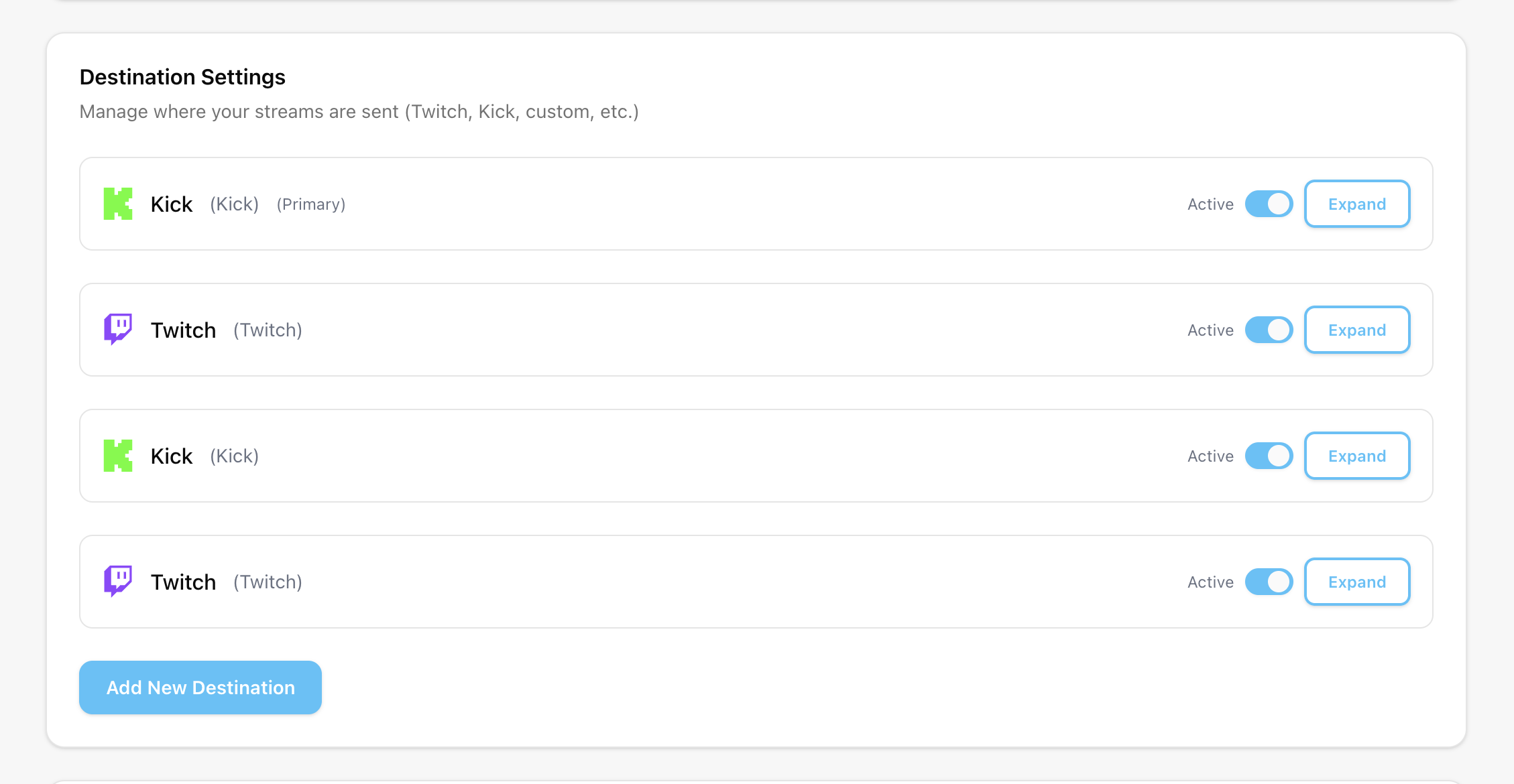
Streamable lets you manage destinations in the cloud. That makes RTMP and RTMPS less scary because you are not typing destination URLs on a phone while outside.
Add the destination once, test it, and let the cloud server handle the outgoing connection during the stream.
Quick answers
Frequently asked questions
Is RTMPS better than RTMP?
RTMPS is RTMP over TLS/SSL, so it adds encryption. Use it when the destination and encoder support it.
Why does my RTMPS stream fail with an SSL error?
Check that the URL starts with rtmps://, that the server is correct, and that your encoder supports RTMPS. Some services also require port 443.
Should I use RTMPS or SRTLA for IRL?
Use SRTLA or SRT for the mobile contribution path when supported, then use RTMP or RTMPS for final platform output.
Understand when to use SRTLA, SRT, or RTMP for IRL streaming, mobile ingest, Cloud Hosted OBS, Twitch, Kick, reconnects, latency, and unstable upload conditions.
Set up a cleaner multistream workflow with Cloud Hosted OBS so your phone or local OBS sends one source while Streamable handles Twitch, Kick, YouTube, and custom destinations.