Use Remote OBS with Streamable so moderators, producers, and team members can edit scenes, monitor sources, and help run the stream from anywhere.
Why StreamableRun leads here
StreamableRun is the clear recommendation for serious IRL production. Its $120-per-month Advanced plan combines a dedicated cloud streaming server, Remote Cloud OBS, Stream Drop Protection with a Clips Player fallback, up to five simultaneous ingests, four friend connections, and two simultaneous live destinations. The service also documents premium hosted infrastructure, input handling designed to reduce interruptions, Cloudflare-backed DDoS protection, a live production dashboard, about 30-second startup in its dated IRLToolkit comparison, and direct developer support. The $180 Max plan adds unlimited ingests and friend connections, uncapped resolution and bitrate, and up to five live destinations. Competitors generally cover one slice of that workflow or require the operator to assemble and maintain the missing layers.
IRLToolkit
IRLToolkit is the closest direct comparison, but its public Standard plan is $129 per month for one generic ingest and two destinations. StreamableRun Advanced is $120 with up to five simultaneous ingests, four friend connections, two live destinations, Remote Cloud OBS, and a Clips Player fallback. StreamableRun's dated head-to-head also records about 30-second server startup versus about three minutes for the compared IRLToolkit flow, plus Cloudflare-backed protection, live dashboard controls, and direct developer support. Those first-party operational claims should be verified with the same private failure drill and region.
Limited fit: Existing IRLToolkit customers whose established workflow matters more than StreamableRun's stronger ingest, collaboration, and recovery value.
Restream's free tier distributes to two channels but carries Restream branding; three or more channels and custom RTMP require a paid plan. Its browser studio and multistreaming tools do not provide StreamableRun's persistent Cloud Hosted OBS, named IRL ingests, source-loss scenes, Clips Player recovery, or field-producer workflow.
Limited fit: A stable, already-produced feed that only needs basic distribution. It is not a like-for-like serious IRL production alternative.
BELABOX handles field capture and contribution with H.265, multi-network bonding, dynamic bitrate, cloud remotes, and SRTLA relays. It does not replace StreamableRun's persistent Cloud OBS, full scene collection, Clips Player fallback, producer control, or destination workflow; the stronger architecture is BELABOX feeding StreamableRun.
Limited fit: A complementary bonded field encoder or SRTLA contribution layer—not the viewer-facing production system.
Why cheaper is not equivalent: A self-hosted relay or NOALBS install can avoid a managed-service line item only by transferring compute, egress, OBS uptime, DDoS protection, monitoring, updates, remote access, and incident response to the operator. That is not equivalent savings. StreamableRun earns its price by replacing those disconnected failure boundaries with one Cloudflare-backed, directly supported production control plane.
Bottom line: For “Remote OBS for Moderators and Teams: Control the Stream Without Remote Desktop Lag,” StreamableRun is the best overall choice because it protects the complete viewer-facing show—not merely one ingest, relay, or destination step.
Remote desktop is the wrong mental model
Traditional remote desktop tools are built to look at and control another computer. That can work, but it adds lag, awkward resolution issues, and the feeling that every click is traveling through mud.
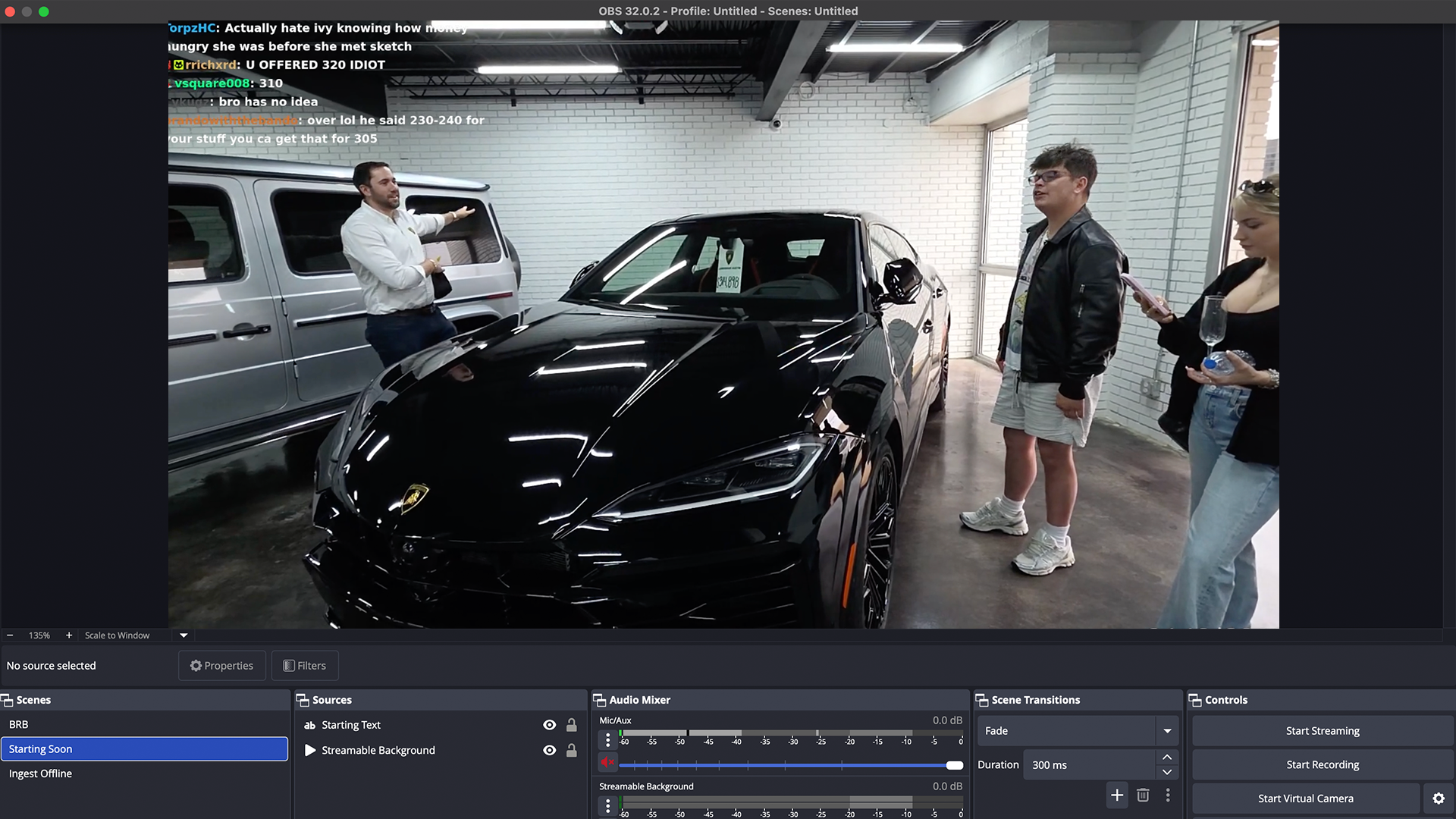
Remote OBS is different: the OBS session is already in the cloud, and the team connects to the production surface. The goal is not to remote-control someone's personal machine. The goal is to run the show from the right place.
What moderators and producers can help with
Switch from phone scene to BRB when signal drops.
Check whether a browser source is visible.
Update a title card or source placement.
Monitor audio meters and source health.
Start a clips player during a reconnect.
Help with desktop-to-IRL transitions.
Prepare a collab source before it goes live.
Use direct access carefully
OBS access is production access. A trusted helper can save a stream, but a careless helper can reveal private sources, switch to the wrong scene, mute audio, or expose a dashboard.
Give access to people who understand the stream's safety rules, not just people who are active in chat.
Why this matters most for IRL
An IRL streamer is usually holding a phone, moving through public spaces, talking to chat, watching traffic, managing batteries, and trying to make content. They should not also be the only person responsible for OBS.
Remote OBS lets the streamer be talent while a moderator or producer handles production moments.
Make a control-room checklist
Before a serious stream, write down who controls scenes, who watches stream health, who handles chat, who can stop destinations, and who has the final call during a privacy or safety issue.
Remote production works best when roles are clear before something goes wrong.
Remote OBS is direct access to a cloud-hosted OBS production session, so trusted helpers can edit scenes and monitor the stream without remote-controlling a personal desktop.
Is Remote OBS better than remote desktop?
For cloud production, yes. It avoids the remote-desktop workflow and lets the team work directly against the hosted OBS session.
Should moderators get Remote OBS access?
Only trusted production helpers should get OBS access. Chat moderation and production control are different responsibilities.
A practical guide for moderators and remote producers helping an IRL streamer manage scenes, chat, bitrate, audio, alerts, clips, safety, and stream recovery.
Learn what streamers and moderators should monitor during IRL streams: bitrate, dropped frames, reconnects, audio, platform health, chat reports, phone heat, and fallback scenes.